Laboratory analysis of agricultural raw materials: sunflower seeds, soybeans, rapeseed and cereals
The appearance of a batch of agricultural raw material does not provide a complete picture of its quality. Sunflower seeds may look clean yet differ in oil content and moisture. Two similar wheat batches may have different protein contents, test weights or gluten characteristics. Soybeans and rapeseed have their own sets of important parameters.
This is why laboratory analysis of cereals and oilseeds is used for more than disputed deliveries. It is needed before purchasing, on receipt, during storage and before processing.
However, reliable results start before the analyser is switched on. A sample representative of the batch must be obtained and prepared correctly, the required parameters identified, and only then should the results be used to make a decision.
When is laboratory analysis of agricultural raw materials needed?
The set of tests depends on the task.
Before purchasing, analysis helps verify the characteristics of the offered raw material and compare them with the buyer’s requirements. For sunflower seeds, key parameters may be oil content, moisture and impurities. For wheat, they may include moisture, protein, test weight, gluten and other parameters, depending on the batch’s intended use.
On receipt, laboratory testing allows the material actually delivered to be assessed and the results compared with the agreed terms.
During storage, parameters affecting batch stability are particularly important. Moisture is one of the basic parameters.
Before processing, results are needed to assess processing potential. For example, the oil content of sunflower seeds shows how much oil is present in the raw material and provides the starting value for a preliminary yield calculation.
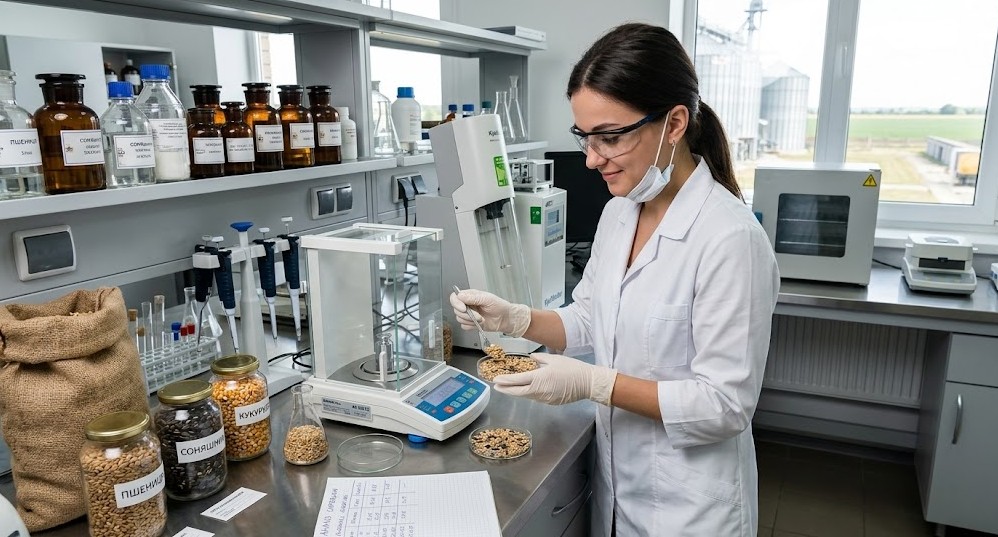
At SeedWay Oil, raw material and product testing is carried out by the company’s own production and process laboratory, so laboratory work is directly linked to receiving and production operations.
Why a proper sample matters as much as the analysis itself
A laboratory does not test an entire truckload, warehouse stock or other large batch at once. Testing is performed on a much smaller quantity of material that must adequately represent the characteristics of the whole batch.
This is the main challenge in sampling.
If the raw material is heterogeneous, grain taken from one location may differ in moisture, impurities or other characteristics from material elsewhere in the batch. A randomly selected handful of grain therefore does not, by itself, guarantee a representative result.
Once collected, the sample must also be prepared for the particular test: divided, reduced, sieved, ground or weighed, as necessary.
For these operations, SeedWay Oil’s laboratory facilities include BIS-1U and DP-10 sample dividers, laboratory mills, grain sieves, balances, a SSh100K drying oven, a PM-450 moisture meter, an Infrascan-105 analyser and other equipment.
The exact number and mass of incremental samples and the sampling procedure depend on the crop, batch type and method. A universal instruction such as “take one sample of a specified weight” would therefore be inappropriate for all agricultural raw materials.
Sunflower seed analysis: oil content, moisture and impurities
For a processor, oil content is one of the main parameters of sunflower seeds.
It indicates the proportion of oil in the seeds and allows the batch’s processing potential to be assessed.
For example, at an oil content of 46%, 1000 kg of seeds theoretically contains approximately 460 kg of oil. This is not yet the actual finished product yield, since the recovery technology must be taken into account, but laboratory determination of oil content provides the starting value for the calculation.
SeedWay Oil’s listed laboratory capabilities include rapid oil content determination and determination using the Soxhlet method.
These are different approaches to the same task. Rapid methods are convenient when a result is needed promptly. The extraction method uses a different measurement principle and requires appropriate laboratory preparation. Results should be compared with reference to the method used, not merely the speed at which a figure is obtained.
In addition to oil content, sunflower seeds are tested for moisture and foreign matter.
Moisture contributes to the physical mass of the batch but is not oil-bearing dry matter. Impurities also increase the total weight, although this part of the batch is not usable seed for processing.
Two truckloads of the same mass may therefore have different processing value.
The possible tests for sunflower seeds also include acid value, which provides additional information about the condition of the raw material’s fat component.
Soybean analysis: protein, moisture and fat
The priority parameters for soybeans differ from those for sunflower seeds.
Soybeans are a source of both oil and protein, so considerable attention is paid to protein content.
This parameter is used to assess the batch’s protein component and suitability for further use. However, protein should not be considered separately from other characteristics.
Moisture indicates the proportion of water in the product’s physical mass, while fat content characterises its oil component.
Impurities may also matter when assessing the batch.
It is therefore inappropriate to use the same set of tests for sunflower seeds and soybeans simply because both are oilseeds. The parameters are selected according to the crop’s properties and the purpose of the testing.
Rapeseed analysis: oil, protein and glucosinolates
Oil content is also important for rapeseed, but laboratory assessment is not limited to this parameter.
SeedWay Oil’s listed laboratory capabilities for rapeseed include determining oil, protein, glucosinolates and GMO/non-GMO status.
Glucosinolates are naturally occurring compounds characteristic of rapeseed. Their content is monitored as a separate parameter when assessing batch quality and suitability for the intended use.
A request for “rapeseed analysis” therefore does not, by itself, define a particular set of tests.
One group of parameters may matter for purchasing, another for process assessment, while additional parameters may be needed to meet a contractual specification.
Analysis of wheat and other cereals
Laboratory testing of cereals follows its own logic. Wheat analysis is a particularly clear example.
Moisture
Moisture indicates the proportion of water in the grain and matters on receipt and during storage.
At the same physical mass, a batch with higher moisture contains less dry matter.
Protein
Protein content is one parameter used to characterise wheat, depending on its intended use and the requirements for the specific batch.
For example, the project’s reference specifications give different minimum protein contents for different wheat classes.
This illustrates why a laboratory result cannot be assessed in isolation from the standard or specification.
Grain test weight
Test weight characterises the mass of a specified volume of grain and is usually expressed in grams per litre.
It is not simply the weight of an arbitrary quantity of grain. The parameter characterises the properties of the bulk grain and is used alongside other parameters when assessing a batch.
Gluten and the IDK index
Total protein is not the only important parameter for wheat.
Wet gluten content may be determined separately, while the IDK index is used to assess gluten deformation properties.
Thus, “gluten” and “IDK” are not two names for the same parameter. They characterise different aspects of grain properties.
For maize and other cereals, the set of tests should be selected separately. Not every parameter relevant to wheat is equally applicable to every cereal crop.
What does a laboratory analysis result mean?
A laboratory figure is not, by itself, a conclusion that a batch is “good” or “bad”.
For example, a laboratory may determine:
moisture: X%;
protein: Y%;
test weight: Z g/L.
These are measurement results.
To use them to make a purchasing, receiving or processing decision, the comparison criterion must be known.
This may be:
- an applicable standard;
- a purchasing specification;
- contract terms;
- the buyer’s internal processing requirements.
The same result may satisfy one contract and fail to satisfy another.
Analysis and interpretation are therefore two successive stages. First, the actual parameter is measured; then it is compared with the criterion used to make the decision.
Is it necessary to determine every possible parameter?
No. The number of tests alone does not make a laboratory assessment more useful.
First, establish which decision the results will support.
For rapid assessment of sunflower seeds on receipt, oil content, moisture and impurities may be priorities.
For wheat, protein, test weight, gluten and IDK may be added to basic parameters to meet specific requirements.
Rapeseed testing may require the determination of glucosinolates or GMO/non-GMO status.
A different task will require a different set of tests.
The practical principle is simple: determine the characteristics on which the specific purchasing or production decision depends, rather than the maximum number of parameters.
What information should be provided before laboratory analysis?
To select the tests correctly, specify:
- the crop to be analysed;
- the batch to which the sample belongs;
- the parameters to be determined;
- the purpose of the result: purchasing, receiving, storage or processing;
- the specification or other requirements against which the measured values should be assessed;
- whether a rapid result or a specific testing method is required.
This helps avoid a situation in which testing has already been completed, but the results are insufficient for the decision for which it was ordered.
For analysis of sunflower seeds, soybeans, rapeseed or cereals at SeedWay Oil, you can provide the crop, batch details and required parameters so that an appropriate set of laboratory tests can be selected.

Fill out the form and we'll get in touch with you!
Contact Information