

Raw material reception
Verification of volume and primary indicators


.png)


.png)
Suitable for soybean producers who want to process their own raw materials into value-added finished products.


Soybean meal is a high-protein product of soybean processing widely used in animal husbandry.
Contains a significant share of protein and nutrients, making it an effective component of compound feeds.
Usage:
Suitable for farms, compound feed plants and enterprises in animal husbandry and poultry farming.

Technical oil is a product of oilseed processing intended for industrial use.
Used as a raw material for the production of biofuel, lubricants and other technical products.
Usage:
Suitable for industrial enterprises, biofuel producers and processing companies.
.svg)
.svg)

.svg)
.svg)
.svg)
.svg)
The client independently ensures the supply of soybeans to the facility.
This is a cooperation format in which the customer provides their own raw materials, and the enterprise processes them and returns the finished products.
The plant is responsible for receiving, storing, and processing raw materials, quality control, and shipment of finished products.
The cost depends on volumes, raw material quality, and the list of additional services (cleaning, drying, logistics).
A processing contract is drawn up, along with raw material acceptance and finished product shipment acts, as well as accompanying accounting documents.
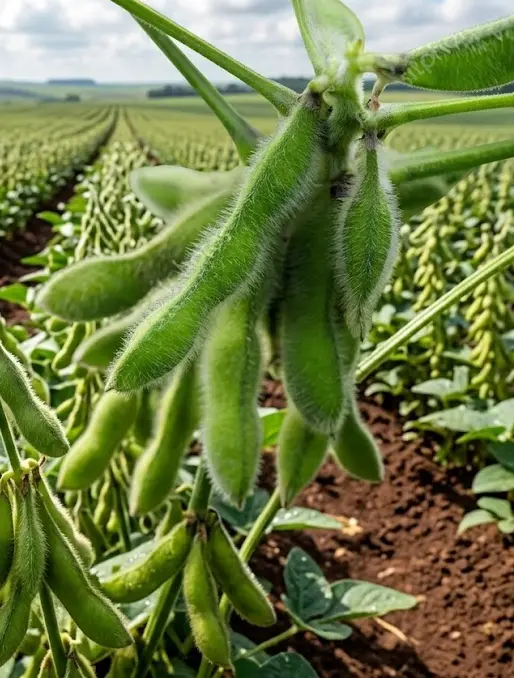
Processing costs are determined individually based on the volume of raw materials, their quality, and the terms of cooperation.
Tolling soybean processing with receipt of finished products and quality control at all stages.
.svg)
.svg)
Tolling soybean processing is a convenient cooperation model for businesses that want to work with their own raw materials without investing in a separate production base, staff, or technological infrastructure. You transfer a batch of soybeans to our production facilities and receive processed products within a clear contractual model.
This approach gives you greater control over the raw material, the production process, and further supply planning. Instead of separately managing intake, storage, weighing, quality control, and logistics, you work with one plant that handles the entire chain of ancillary tasks within a single partnership.
Tolling soybean processing suits agricultural producers, traders, commodity batch owners, and B2B companies that want not merely to sell raw materials but to work with them in a more controlled way. It is a practical solution for seasonal batches, regular shipments, and contract cooperation where predictability, control, and stability are essential.
If maintaining control over the batch, operating in a clear production mode, and reducing operational burden are critical for you, the tolling scheme provides exactly that advantage. Rather than splitting the process among multiple contractors, you obtain a more integrated working model where it is easier to plan timelines, coordinate dispatch, and oversee ancillary processes.
At our production facilities we work with the production of oils, meals, and cake. Soybean meal is a distinct product in the company's range, so soybean processing is part of a real production model for the plant, not just a formally declared service.
For you this means a practical and clear cooperation result. What matters is not only the fact of accepting a soybean batch but that we treat processed products as a full part of our operational activity. This provides greater confidence in process stability and confirms that processing is organized on the basis of operating capacity.
When choosing a plant for soybean processing, consider more than just the service price. Equally important for your business are transparent raw-material intake, correct weighing, quality control, the availability of storage infrastructure, logistics capabilities, and operational stability in season.
How convenient it will be to work with the contractor in day-to-day operations also matters. If accounting, laboratory control, or delivery coordination is poorly organized, even an attractive price can turn into delays, complex approvals, and additional costs. When intake, production, storage, and dispatch are built systematically, cooperation becomes far more predictable.
We use automated intake, weighing equipment, our own production and technology laboratory, a storage base, and an in-house fleet of 18 vehicles. Storage and raw-material processing are carried out at a production complex in Mykolaiv Oblast. This allows us to control the movement of raw materials and finished products more effectively and to offer partners a more organized production route.
In tolling soybean processing, the commercial result depends not only on cooperation terms but on how precisely raw-material assessment, accounting, and quality control are organized. These elements allow you to plan work based on actual batch parameters rather than assumptions.
We accept soybeans in accordance with DSTU 4964:2008, including GMO considerations. We also perform laboratory quality analyses so you can understand the batch parameters at the intake stage. This reduces the risk of disputes, helps organize further work with the raw material more accurately, and makes cooperation more predictable for your business.
Transparent accounting and correct weighing are no less important than the production process itself. When batch movement is clear and raw-material indicators are properly recorded, it is easier to assess processing viability, coordinate deliveries, and make further commercial decisions.
The quality of a soybean batch directly affects how smoothly and predictably processing will be organized. That is why raw-material requirements should be seen as a practical foundation for correct production interaction.
Moisture content determines the condition of the batch at intake and during storage. Elevated or unstable moisture complicates raw-material preparation, affects the overall production mode, and may create additional technological risks. This indicator is always assessed in combination with other characteristics.
The impurity level reflects the degree of batch preparation. High foreign matter content complicates intake, increases the cleaning load, and affects production process coordination. This is one of the basic parameters for correctly organizing processing.
Uniformity provides an understanding of raw-material stability. If the batch is uneven, production planning is harder, the risk of equipment deviations increases, and result predictability decreases. A stable batch structure is the foundation of predictable plant operation.
All soybean batches are evaluated under current standards. The primary standard is DSTU 4964:2008 (including GMO). Compliance establishes a clear regulatory basis, reduces the risk of disputes during assessment, and ensures transparent cooperation. Processing organization depends directly on raw-material quality. Key indicators—moisture, impurities, and uniformity—determine not only the technical side of the process but also the ability to plan it accurately. That is why batch assessment is always conducted comprehensively, taking into account all parameters and standard compliance.
One of the most common mistakes is evaluating soybean processing solely by service cost. In practice, a lower rate does not always mean better economics. If it comes with weak intake organization, non-transparent accounting, absent laboratory control, or logistics problems, part of the benefit quickly disappears in delays, additional approvals, and excess operational burden.
Another mistake is underestimating the importance of input batch quality. If soybeans are transferred for processing without sufficient attention to key indicators, it complicates processing organization and makes the result less predictable. Logistics should also be thought through in advance: when transport, storage, and batch coordination issues are not planned ahead, even a normal production process can start to fail.
We structure cooperation so that you can work conveniently not only at the processing stage but across the entire operational cycle. Intake, accumulation, storage, weighing, laboratory support, and transportation work as part of a single production loop. For you this means fewer gaps between stages, better coordination, and more predictable work with your batch.
We have over 20 years of experience, 500,000+ tonnes of processed raw materials, 200+ partners, and 98% of orders fulfilled on time. For you these are not just figures but an indicator that cooperation is built on real capacity, a systematic approach, and production discipline. That is why soybean processing at our facilities is not just a standalone service but a working tool for businesses that value control, stability, and a predictable result.
.webp)
The minimum processing volume is 1,000 tonnes of raw materials.
Yes, every soybean batch undergoes laboratory quality control on the main quality indicators before processing.
Yes, the company has its own freight vehicle fleet for transporting raw materials and finished products.
Raw material intake, storage, and processing are carried out at production facilities in Mykolaiv Oblast.
The plant ensures processing of significant raw material volumes and has a well-developed production infrastructure with laboratory quality control.
.webp)

.webp)
.svg)
.svg)
.webp)
.webp)
.webp)
.webp)
.webp)
.svg)