Sunflower hull pellets and briquettes: which should you choose for your boiler?
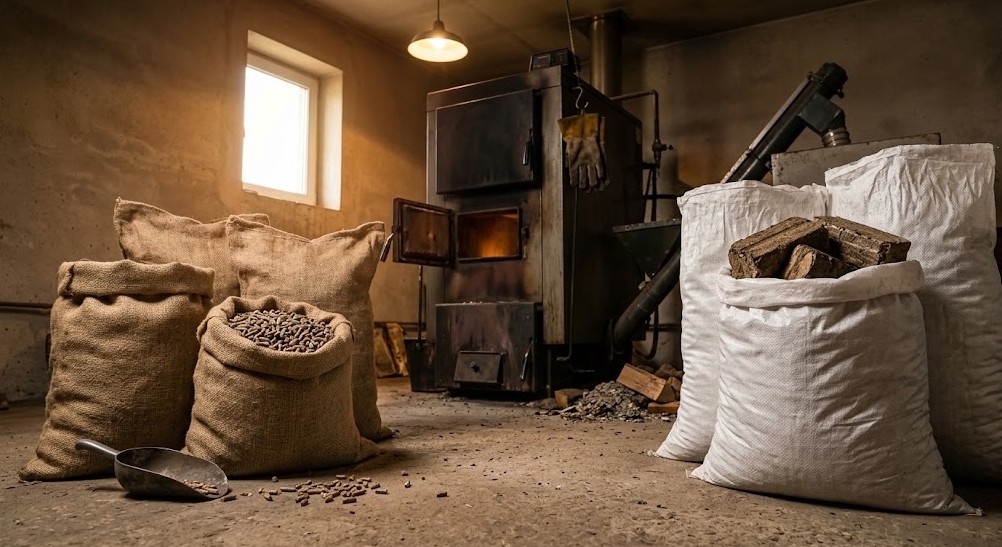
Pellets and fuel briquettes made from agricultural raw materials are used as solid biofuel in boiler houses, industrial facilities, warehouse complexes and agribusiness. However, a common raw material source does not mean that both formats are equally suitable for every boiler.
Pellets and briquettes differ primarily in their geometry and how they are fed into the combustion chamber. Fuel selection must also account for calorific value, moisture, ash content, boiler characteristics and the unit’s actual efficiency.
The right question is therefore not “which is better: pellets or briquettes?”, but “which fuel is compatible with this boiler, and how much useful heat can it produce?”
Where does sunflower hull fuel come from?
Hulls are generated directly during sunflower seed processing.
At SeedWay Oil, kernels are separated from their shells before mechanical pressing. The material passes through seed separators, and the hulls are further cleaned using re-separation equipment and beater separators before entering a holding hopper.
The main production documentation lists sunflower hulls as a separate co-product of the company.
For further use as fuel, plant material can be compacted to obtain a more compact product.
SeedWay Oil’s project product range includes fuel briquettes, sunflower hull pellets and pellets made from agricultural residues.
How do pellets differ from briquettes?
The most obvious difference is size and shape.
Pellets are small compressed granules. Their geometry allows use in automatic feeding systems, provided that the particular burner, auger and boiler are designed for that type of pellet fuel.
Briquettes are considerably larger.
For the cylindrical briquettes described in SeedWay Oil’s project reference data, the stated dimensions are:
- diameter: 65 mm;
- length: 220–300 mm.
Clearly, a briquette of this size and a small fuel pellet require different feeding systems.
Selection should therefore start with the boiler’s technical documentation, rather than fuel price: which fuel types are permitted, which sizes the feeding system can handle, and how fuel is loaded into the combustion chamber.
Calorific value: how much energy does the fuel contain?
Calorific value indicates the fuel’s energy potential.
The project specification gives a range of 16.8–17.4 MJ/kg for cylindrical briquettes.
For a thermal calculation, this value can be converted to kWh per kilogram.
Since:
1 kWh = 3.6 MJ,
for an illustrative example with a calorific value of 17.1 MJ/kg:
17.1 ÷ 3.6 ≈ 4.75 kWh/kg.
However, this is the energy contained in the fuel. The boiler does not transfer all of it to the heat transfer fluid.
If an efficiency of 85% is used for the calculation:
4.75 × 0.85 ≈ 4.04 kWh of useful heat per 1 kg.
The 85% efficiency in this example is not a specification of a SeedWay Oil boiler or any particular unit. It is an assumed value used only to demonstrate the calculation principle.
Moisture: why dry fuel matters
Water in the fuel does not generate useful thermal energy. During combustion, some heat is used to warm and evaporate it.
Moisture is therefore directly related to how the fuel actually behaves in the boiler.
For cylindrical briquettes, SeedWay Oil’s project specification gives a moisture content of up to 6.5–6.8%.
Storage after delivery is equally important. If compressed fuel absorbs moisture in the buyer’s warehouse, its actual characteristics may differ from those at dispatch.
This is why the project materials recommend storing briquettes in dry premises with moisture control.
Ash content: how much residue must be removed?
After the organic part of the fuel burns, a mineral residue remains: ash.
The project specification gives an ash content of up to 0.3–0.8% for cylindrical briquettes.
In practical terms, boiler house operation must account not only for heat output, but also for cleaning the combustion chamber and removing residue.
However, low ash content alone does not guarantee the absence of slagging or deposits. Ash behaviour also depends on its composition, combustion temperature, boiler design and air supply settings.
When selecting agricultural biofuel, calorific value and ash content must therefore be considered alongside the requirements of the specific equipment.
How to estimate fuel consumption
An initial assessment requires three parameters:
- the required thermal output of the boiler house;
- the fuel’s calorific value;
- boiler efficiency.
The simplified calculation is:
fuel consumption, kg/h = required thermal output, kW ÷ useful heat energy per 1 kg of fuel.
Use the previous illustrative example.
Calorific value:
17.1 MJ/kg ≈ 4.75 kWh/kg.
Assumed boiler efficiency:
85%.
Useful heat:
4.75 × 0.85 ≈ 4.04 kWh/kg.
If the facility needs a continuous thermal output of 100 kW:
100 ÷ 4.04 ≈ 24.8 kg/h.
For 10 hours of operation at this load, the mathematical estimate is approximately 248 kg of fuel.
However, this is a calculation example, not a guaranteed actual consumption figure.
In practice, a boiler does not necessarily operate continuously at its rated load. Consumption is affected by actual efficiency, fuel quality, heat transfer fluid temperature, air supply settings, building heat losses, outdoor temperature, start-up, shutdowns and partial-load operation.
The formula is therefore useful for planning stock, while actual consumption must be checked on the specific equipment.
Why boiler output alone is not enough to select fuel
The request “we have a 500 kW boiler: how many pellets do we need?” does not contain all the required information.
For selection, it is important to know:
- the boiler make and model;
- rated output;
- the combustion chamber or burner type;
- permitted fuel types;
- permitted fuel size;
- the feeding method;
- efficiency, if known;
- the operating regime;
- actual consumption of the current fuel, if the boiler house is already in operation.
Checking the boiler manufacturer’s requirements is particularly important.
If the specific design is not intended for a particular agricultural fuel or its geometry, a suitable calorific value does not, by itself, make that fuel compatible with the equipment.
Pellets or briquettes: how to decide
Instead of looking for a universally “better” option, it is more useful to follow a series of steps.
First, check which fuels the boiler permits.
Then establish how the fuel enters the combustion chamber. An automatic pellet burner with a small auger and a system designed for large cylindrical briquettes require different fuel geometries.
Next, obtain the characteristics of the specific batch:
- composition;
- calorific value;
- moisture;
- ash content;
- size and shape.
The estimated consumption can then be calculated using the unit’s efficiency.
Only then should price, delivery and storage be added to the comparison.
The practical sequence is:
boiler → feeding system → fuel characteristics → expected consumption → logistics → price.
Why price per tonne does not show the full economics
When looking for sunflower hull pellets or fuel briquettes, it is natural to compare the cost per tonne first.
For a boiler house, however, the more important question is how much useful heat that tonne will actually provide.
The price comparison must therefore also include:
- calorific value;
- moisture;
- boiler efficiency on the specific fuel;
- expected consumption;
- ash content and operating characteristics;
- delivery.
For example, a cheaper fuel may require a higher mass consumption rate. Another may cost more per tonne but better suit the particular unit’s operating regime.
The cheapest tonne of fuel and the cheapest unit of useful heat are therefore not necessarily the same.
How to store pellets and briquettes
The main aim when storing compressed biofuel is to protect it from moisture.
SeedWay Oil’s project documentation specifically recommends dry premises and moisture control for briquettes.
In practice, this means:
- protecting the product from rain and snow;
- not placing packages directly on a wet surface;
- avoiding persistent condensation;
- protecting packaging from damage;
- planning warehouse stock around actual consumption.
The reference data confirms 10 kg packaging for cylindrical briquettes and two pallet configurations: 800 and 960 kg net.
For example, storing 8 tonnes of this fuel would require approximately 10 pallets of 800 kg, or another combination based on the actual dispatch format.
The project reference data does not specify separate packaging for pellets, so their delivery format must be clarified separately.
What to tell the supplier before selecting fuel
To obtain a specific offer, provide:
- the boiler model;
- output;
- burner or combustion chamber type;
- the feeding system;
- permitted fuel type and size;
- efficiency, if known;
- the boiler house operating regime;
- current fuel consumption, if such records are available;
- the required volume;
- the delivery address.
This makes it possible to assess a specific fuel for a specific unit, rather than abstract “pellets or briquettes”.
SeedWay Oil’s biofuel range includes fuel briquettes, sunflower hull pellets and pellets made from agricultural residues. To select an option and calculate a delivery quote, provide the boiler parameters, required volume and delivery location.

Fill out the form and we'll get in touch with you!
Contact Information