Rapeseed or sunflower meal: what is the difference and which should you choose?
Rapeseed and sunflower meal are used as protein feed ingredients, so buyers often compare them. The simplest approach is to look at protein content and price per tonne. This is not enough for a practical decision.
These meals are made from different oilseed raw materials, so their compositions and characteristics differ and must be considered in a formulation. Glucosinolates may require particular attention in rapeseed meal, while the proportion of hull material, which is related to fibre content, is important for sunflower meal.
The question should therefore not be “which meal is better?”, but “what are the parameters of these two specific batches, and which one better meets the required formulation?”
What do rapeseed and sunflower meal have in common?
Both products are obtained during oilseed processing after most of the oil has been recovered.
Protein, fibre, minerals and other components of the original raw material remain in the solid product. This is why meals are used as feed ingredients and protein sources in compound feed formulations.
However, the word “meal” does not imply an identical composition.
Rapeseed and sunflower seeds differ in structure and chemical composition. The finished product’s characteristics are also affected by raw material quality, preparation for processing, the degree of dehulling and the oil recovery technology.
SeedWay Oil’s product range includes both sunflower and rapeseed meal. A batch assessment should be based on its current laboratory results.
Protein: can you simply choose the higher percentage?
Protein is one of the first parameters a buyer checks in a feed ingredient.
SeedWay Oil’s reference specifications state a minimum crude protein content of 39% on an absolutely dry matter basis for sunflower meal.
The available materials do not contain a confirmed internal specification for rapeseed meal. Purchasing decisions should therefore use laboratory results for the specific batch, rather than a notional “average protein content of rapeseed meal”.
Another consideration is the basis on which the figure is reported.
An absolutely dry matter basis excludes all moisture. If one meal’s protein is reported on this basis and the other’s is reported at actual product moisture, directly comparing the two percentages is incorrect.
The values must first be converted to the same basis.
The question to the supplier should therefore be not only “how much protein?”, but also “on what basis is this figure reported, and does it relate to the current batch?”
Fibre: why it should be assessed alongside protein
High protein alone does not determine whether a meal suits a particular formulation.
Hulls are an important component of sunflower products. The more hull material remains in the meal, the more it may affect fibre levels and the concentration of other nutrients.
SeedWay Oil’s reference specifications state a maximum crude fibre content of 23% on an absolutely dry matter basis for sunflower meal.
Rapeseed meal also contains fibre, but its composition comes from a different raw material. Our reference data does not contain a confirmed SeedWay Oil rapeseed meal specification, so an actual laboratory result is needed for comparison.
In practice, protein and fibre should be assessed together.
A batch may have an attractive protein figure, but other characteristics may limit how much of that product can be included in a specific formulation. This is why choosing solely on the highest protein figure often gives an incomplete picture.
Glucosinolates: a separate factor for rapeseed meal
Rapeseed has a specific characteristic that does not apply when assessing sunflower meal: glucosinolates.
These are naturally occurring compounds in rapeseed whose content may matter when the product is used in feed. For formulations where this parameter is critical, it must be checked separately.
SeedWay Oil’s laboratory reference data includes glucosinolate determination for rapeseed.
However, there is an important distinction: a seed result cannot automatically be applied to rapeseed meal after processing.
Finished meal requires a separate analysis or specification for the particular batch.
This example illustrates why rapeseed and sunflower meal cannot be compared properly using only two columns labelled “protein” and “price”.
Residual fat and moisture
Two further parameters worth checking are fat and moisture.
Residual fat indicates how much oil remains in the solid product after processing.
SeedWay Oil’s reference specifications state a maximum fat content of 1.5% for sunflower meal. No confirmed internal value is available for rapeseed meal, so it must be taken from the batch analysis.
Moisture matters for a different reason.
The buyer pays for a physical tonne of goods, part of which is water. With different moisture contents, a tonne of each product will therefore contain different amounts of dry matter.
Our reference specification gives a moisture content of 10% for sunflower meal.
When protein is reported on an absolutely dry matter basis, moisture is particularly important in translating the laboratory percentage into the actual amount of nutrients present in a commercial tonne.
A commercial comparison based only on protein percentage can therefore be misleading.
Can sunflower meal be replaced with rapeseed meal at a 1:1 ratio?
Automatically replacing one tonne of sunflower meal with one tonne of rapeseed meal on weight alone is inappropriate.
Changing the raw material type may also change:
- protein;
- fibre;
- residual fat;
- moisture;
- the proportions of nutritional components;
- specific limiting parameters.
This changes the meal’s contribution to the overall formulation.
If the new product has different proportions of protein, fibre and other components, the quantities of the remaining feed ingredients may need adjustment.
For rapeseed meal, parameters specific to rapeseed raw material are also considered where they matter for the particular ration.
Replacing one meal with another is therefore not a simple “tonne for tonne” operation, but a recalculation of the formulation.
The specific permitted inclusion rate is determined with reference to animal species, age, productivity and the full composition of the ration. There is no universal inclusion rate for every farm.
Which is more economical: rapeseed or sunflower meal?
At the purchasing stage, it is natural to compare both products first by price per tonne.
However, a cheaper tonne does not necessarily mean a cheaper formulation.
For a more meaningful comparison, change the sequence:
price → moisture → protein → fibre → fat → specific parameters → effect on the formulation → logistics.
For example, one batch may cost less, but its composition may mean that the feed formulator can use a smaller proportion of it or must compensate for certain characteristics with other ingredients.
Another meal may have a higher purchase price but better meet the target formulation.
The economic comparison therefore concerns not simply two prices per tonne, but two specific specifications and their effects on the cost of the finished feed.
It is also useful to consider how much dry matter and how much of the required nutrient are actually being purchased in one commercial tonne.
This calculation provides more information than an isolated protein figure on a price list.
What to check before purchasing
Before agreeing on rapeseed or sunflower meal, request current results for the specific batch offered.
First, clarify:
- actual crude protein;
- the basis on which protein is reported;
- moisture;
- crude fibre;
- residual fat;
- for rapeseed meal, specific parameters important to the particular formulation;
- the date and identification of the analysis;
- the available volume;
- the dispatch format;
- delivery terms.
If the company has not previously used this product, it is advisable to assess a representative sample and recalculate the formulation using its actual characteristics before making a substantial purchase.
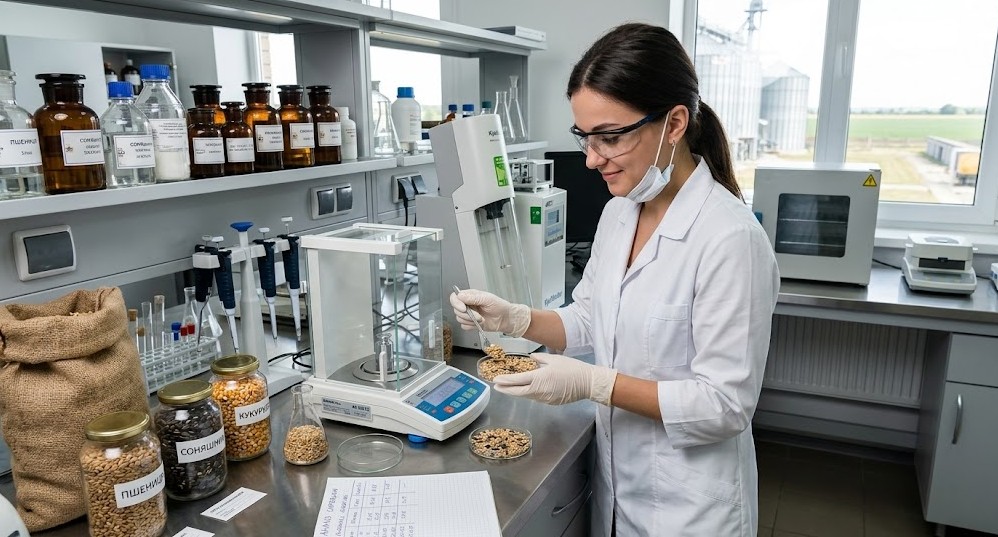
At SeedWay Oil, raw material and product quality is monitored by the company’s own production and process laboratory. Buyers nevertheless need a current specification for the specific meal batch available.
The choice between rapeseed and sunflower meal should therefore start with formulation requirements. The next step is to compare the actual batch compositions, followed by their prices and logistics.

Fill out the form and we'll get in touch with you!
Contact Information