


What determines thepurchase price of sunflower seeds?
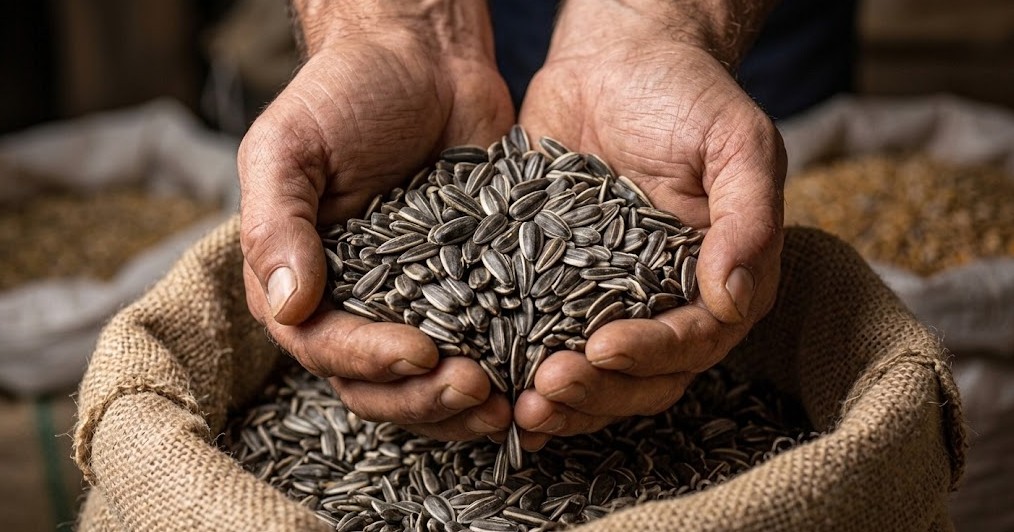
What determines the purchase price of sunflower seeds?
The purchase price for sunflower is not a single fixed figure for any batch. The market price sets a guideline, but the specific offer depends on the characteristics of the seed itself: oil content, moisture, impurity content, batch volume, and delivery conditions.
Therefore, two batches of 100 tons offered to the same processor on the same day may receive different evaluations. One will have higher oil content and fewer impurities, while the other will require additional cleaning or have higher logistics costs.
To understand the real value of your sunflower, you should look not only at the announced price per ton, but also at the quality and delivery conditions for which it is designed.
How is the purchase price for sunflower formed?
Initially, the processor focuses on the current market situation. It is influenced by seed supply, demand from factories, the season, the cost of processed products, and logistics. This level can be conditionally called the market base.
The next stage is the evaluation of a specific batch.
The processor buys not just a physical ton of seeds. He is interested in how much raw material is suitable for processing in this ton and what is the potential yield of the product. This is where oil content, moisture content, and waste content are important.
After that, the volume and terms of delivery are taken into account. The distance to the enterprise, the amount of transport required, the place of loading and the organization of transportation affect the economics of the entire operation.
In simplified form, the logic is as follows:
market situation → batch quality → volume → logistics → actual acceptance results.
That is why the query "what is the price of sunflower seeds today?" only gives a guideline. For a more accurate answer, you need to know the parameters of a specific batch.
Oiliness: why this indicator is important for the processor
Oil content characterizes the oil content in seeds. For a sunflower processing enterprise, this is one of the key economic indicators: other things being equal, raw materials with higher oil content have a higher potential yield of the main product.
This is clearly seen in the production example of SeedWay Oil. According to the company, the technology allows to extract up to 98.9% of the oil contained in the seeds. For a batch weighing 1000 kg with an oil content of 46% in technological materials, the calculated yield is about 455 kg of oil.
But this does not provide a universal formula for the purchase price. Processors may use different baseline conditions, premiums, or adjustments stipulated in the contract. Therefore, oil content should be considered as one of the evaluation factors, and not as the sole indicator of value.
How humidity affects batch evaluation
The total mass of seeds includes water. If the humidity is increased, the proportion of dry matter in each physical ton decreases.
This is of practical importance for the processor. Raw materials with high moisture content may require additional preparation for storage or processing. In addition, the stability of the seeds during storage depends on moisture content.
Therefore, it is worth knowing the indicator before negotiating the delivery. If the seller only reports the weight of the batch, but does not know its moisture content, the price calculation remains less accurate.
It is also important to distinguish between two concepts: the normative or baseline indicator and the actual purchasing conditions of a particular enterprise. The exact adjustment for humidity deviations is determined by the buyer and the terms of the contract.
Why is garbage admixture taken into account?
The waste admixture increases the physical mass of the batch, but is not a full-fledged oil raw material.
If a conventional machine weighs 20 tons including seeds and additives, for the processor, it is not only the number on the scales that matters, but also what part of this mass can actually be used in production.
Higher contamination also means additional strain on the cleaning system. Therefore, the indicator is taken into account together with oiliness and moisture when evaluating a batch.
Hence the practical conclusion: comparing two proposals based solely on the physical weight of the batch is not enough. The quality of this mass is no less important.
Why do you need a laboratory analysis of sunflower seeds?
Before actual acceptance, the purchaser works with the information provided by the seller. If the farm already has the results of the analysis, they help make the preliminary calculation much more accurate.
But during acceptance, the batch parameters are checked by sampling. The laboratory allows you to determine the actual oil content, moisture and impurity content and compare them with the declared indicators.
That is why laboratory analysis is not a formality before unloading. It provides a quantitative characteristic of the raw material, which can be used as a basis for the final determination of acceptance conditions.
At SeedWay Oil, raw materials and finished products are controlled by our own production and technological laboratory. The company's equipment includes an Infrascan-105 analyzer, a PM-450 moisture meter, a drying cabinet, and laboratory mills.
Why the preliminary and final price may differ
Let's say the seller has provided the batch size, estimated oil content, moisture content, and loading location. Based on this information, the buyer can make a preliminary estimate.
After the machine arrives, actual data appears: weight and laboratory test results.
If they confirm the declared characteristics, the initial conditions remain valid. If the laboratory shows a different oil content, higher moisture content or a different amount of impurities, the calculation can be adjusted according to the agreed purchase conditions.
Therefore, it is more correct to distinguish between the preliminary price and the price after confirmation of the batch characteristics.
The more accurate the data the seller provides at the beginning of negotiations, the less likely there will be a significant difference after acceptance.
How volume and logistics affect a deal
Batch size alone does not make seeds better quality. But it does affect the organization of supply.
For 20, 100 or 500 tons, a different number of trips, a different acceptance schedule and different transport costs are required. The location of the sunflower is also important: the same batch of the same quality may have a different logistical component depending on the distance to the enterprise.
Therefore, the statement “the larger the batch, the higher the price per ton” is not a universal rule. The entire economics of the supply need to be assessed.
SeedWay Oil has its own fleet of 18 trucks, including tractor units, tank semi-trailers, and dump trucks. Having its own transport helps with logistics, but the specific transportation format is still agreed upon for each delivery.
How to correctly compare offers from buyers
The highest number in the ad does not always mean the best final result for the seller.
Before comparing two offers, it is worth finding out for which quality indicators the price is stated, where the acceptance takes place, who pays for the delivery, and how deviations of the actual indicators from the agreed ones are taken into account.
For example, one offer may have a higher initial price, but shipping at the seller's expense. Another may have a different logistics model. Without these conditions, a comparison based solely on the cost per ton would be incomplete.
It is also necessary to clarify when the price is fixed: before delivery according to the declared parameters or after laboratory quality confirmation.
As a result, the seller is not interested in the maximum figure in the first message, but in a clear calculation for his specific batch.
What data to prepare for preliminary calculation
To receive a substantive assessment before shipment, it is advisable to prepare:
- actual or estimated batch volume, t;
- storage and loading location;
- oiliness, if there is a current analysis;
- humidity;
- garbage admixture;
- information about possible delivery methods;
- date of the last laboratory analysis.
If some of the indicators are missing, this does not mean that negotiations are impossible. But it is worth noting right away which characteristics have already been confirmed by the analysis and which are still indicative.
What to check before selling sunflowers
Before contacting the purchaser, it is useful to double-check the volume of the available batch, the relevance of laboratory indicators, and the exact location of shipment.
If the analysis was performed a long time ago or the storage conditions have changed since then, it is better not to take its results as guaranteed for the entire current batch.
When comparing buyers, you need to look at the full set of conditions: quality requirements, logistics, acceptance procedure, and the mechanism for determining the final price.
Then the question "where to buy sunflower seeds more expensively" changes to a more practical one: "how much will I receive for my batch with specific indicators and delivery terms."
For a preliminary assessment of a SeedWay Oil batch, it is sufficient to provide its volume, location, and available quality indicators.
.webp)
Fill out the form and we'll get in touch with you!
Contact Information

.svg)
.svg)

.svg)